From Half-Baked to Fully Cooked: A Recipe for Better User Stories
Authors: Sabrina Gubik and Seid Adem
Quick test: Which of these is a user story?
A) Add a search feature
B) The system shall provide search functionality
C) As a caseworker, I want to search applications by case number so that I can quickly locate a specific case
D) Users need better search
If you picked C, you’re ahead of most teams. If you hesitated, keep reading.
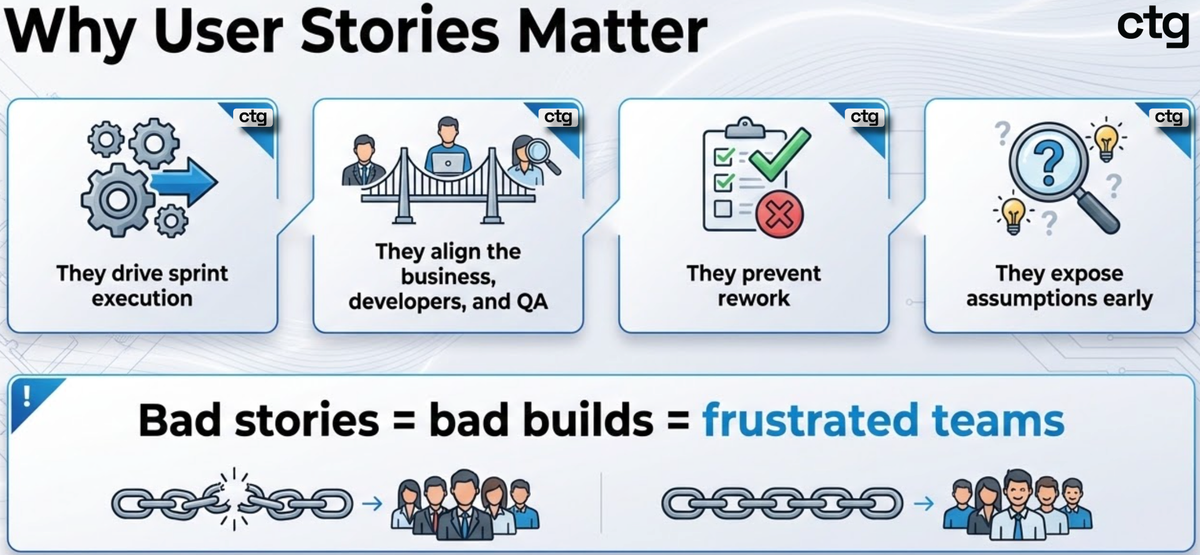
Because here’s the reality: Half-baked stories lead to half-baked builds, and nobody wants to eat that.
Across teams, we see the same patterns:
- Vague one-liners sitting in Jira
- Developers guessing at intent
- Features getting built, reviewed, and then rebuilt
Every gap in a story costs time, morale, and money.
The difference between a weak story and a strong one usually comes down to three things: Context, value, and clarity on what “done” actually means.
Think of it like the difference between handing someone a grocery list and handing them a recipe.
What a User Story Actually Is (and What It Isn’t)
A user story is not:
- A task
- A technical requirement
- A placeholder for “we’ll figure it out later”
A user story is a clear, value-driven description of a need from the user’s perspective.
The classic format is:
As a [user], I want [capability] so that [value].
And the most important part? The “so that.”
That’s where teams either get it right — or completely miss the point.
Because without the “so that,” you’re not building for a user. You’re just building… something.
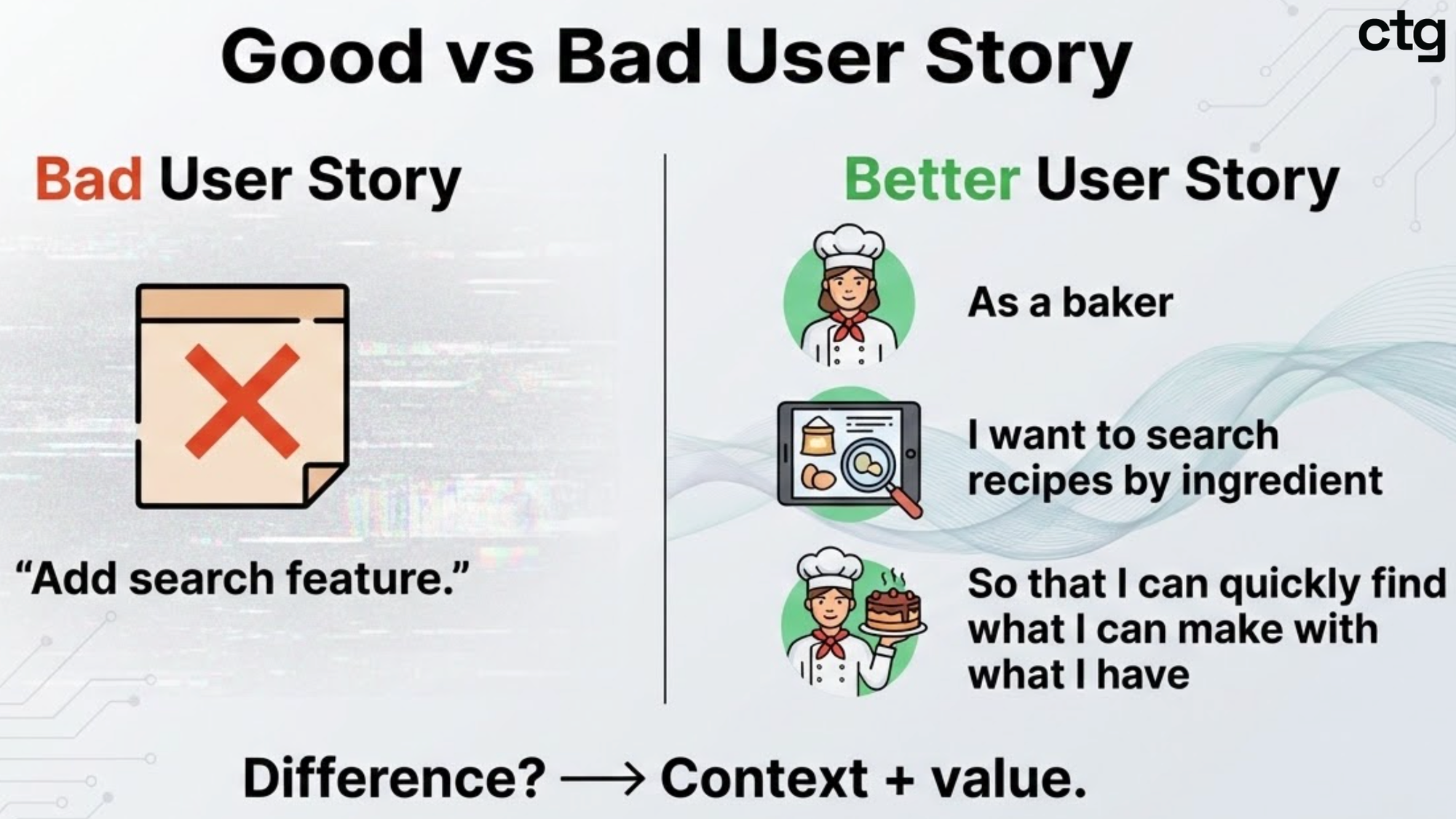
For example:
“Add a search feature.” → no context, no user, no value
“As a caseworker, I want to search by case number so that I can quickly locate a case.” → now we know who, what, and why
That shift is what turns work into purpose-driven delivery.
The INVEST Checklist: A Reality Check for Your Stories
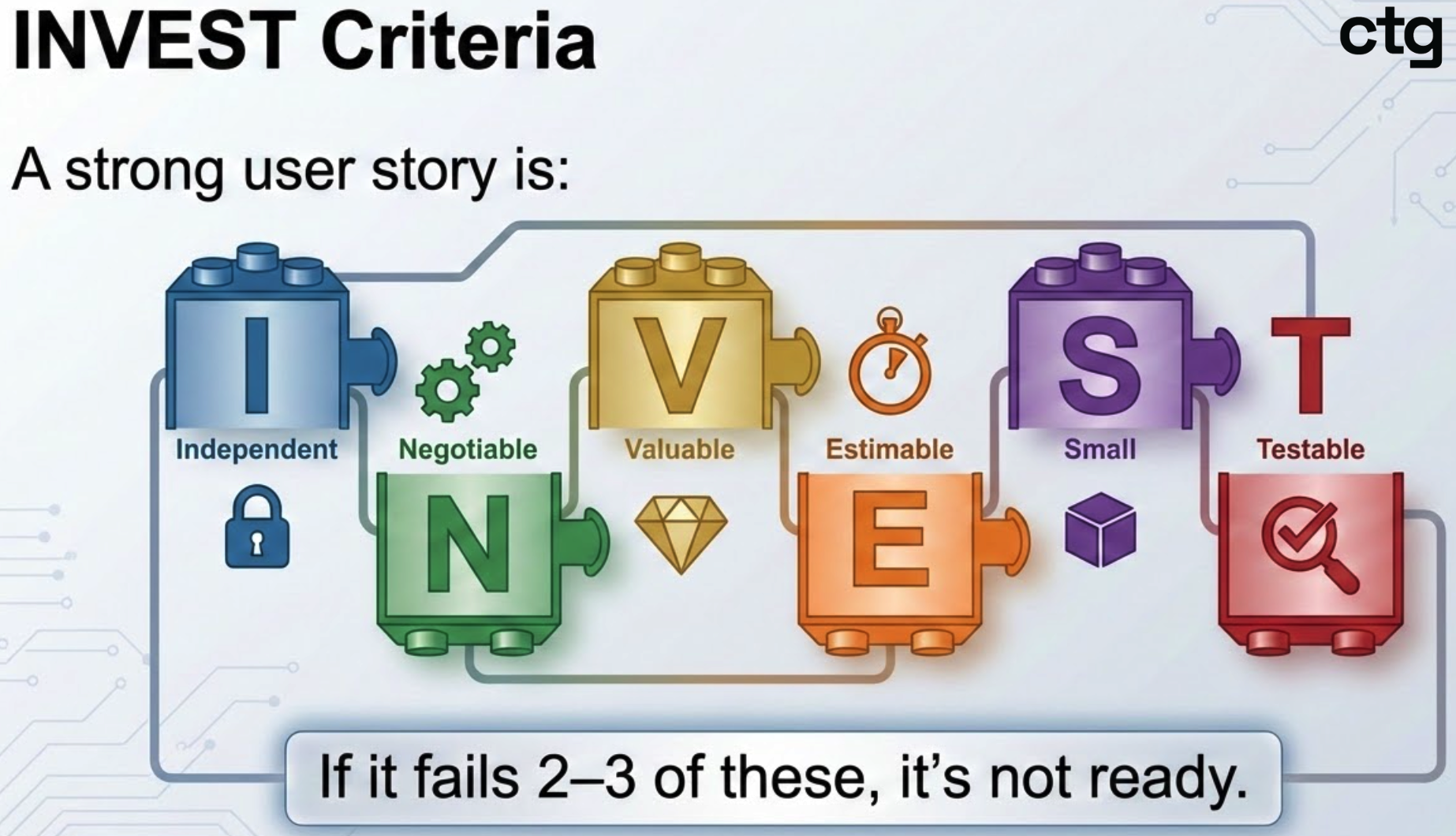
Most teams have heard of INVEST. Fewer actually use it.
Here’s the breakdown:
- Independent - Can it stand on its own?
- Negotiable - Is it a conversation, not a contract?
- Valuable - Does it deliver real user or business value?
- Estimable - Can the team size it?
- Small - Can it fit within a sprint?
- Testable - Can we clearly verify it?
Where do teams struggle most? Independence and Testability.
In real life, when a story fails INVEST, it looks like:
- Stories blocked by hidden dependencies
- Developers asking basic clarification questions mid-sprint
- QA unsure what “done” actually means
- Spillover work that should’ve been caught earlier
INVEST isn’t a checklist to memorize, it’s a sanity check.
If your story fails two or three of these, it’s not ready. Simple as that.
Acceptance Criteria: The Taste Test
If the user story is the recipe, acceptance criteria is the taste test.
It answers one critical question: How do we know this actually works?
Given/When/Then is a common format:
- Given a condition
- When an action occurs
- Then this outcome should happen
But here’s the part teams don’t always say out loud:
You don’t have to use the format every time.
What matters is that your acceptance criteria clearly define:
- Conditions
- Actions
- Expected outcomes
For example:
Weak:
- Search works correctly
Stronger:
- User can search by case number
- System returns matching case within 2 seconds
- If no results are found, user sees a “No results” message
Same idea, different format, but still clear, still testable.
Without acceptance criteria, the team is basically guessing whether the cake turned out right. And guessing is where rework lives.
Clarity Over Format
Structured formats like:
- “As a…, I want…, so that…”
- “Given, When, Then”
are helpful — but they’re not the goal.
Clarity is the goal.
In a recent CTG Agile Center of Excellence (COE) session, we emphasized that forcing strict formats doesn’t always make sense. In some cases, it actually makes stories harder to understand.
Instead, every story and acceptance criteria regardless of format should answer:
- Who is this for?
- What is needed?
- Why does it matter?
- Under what conditions does this work?
- What does success look like?
If those answers are clear, the team can build and test confidently.
If they’re not, the format won’t save you.
Refinement Is a Group Bake, Not a Solo Recipe
One of the biggest misconceptions in Agile? That user stories are owned by one person.
They’re not.
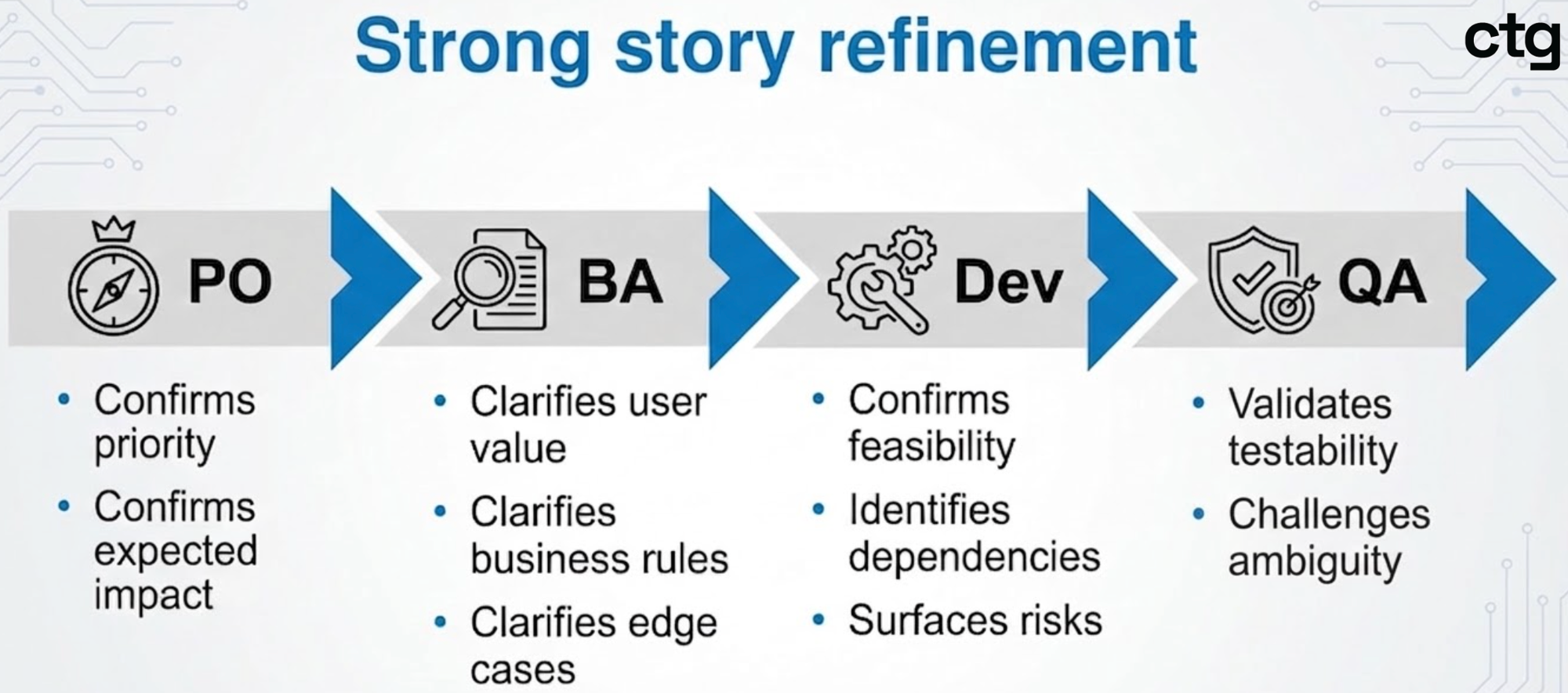
Strong stories are shaped through collaboration:
- Product Owners bring priorities and business context
- Business Analysts drive clarity and structure
- Developers validate feasibility and surface gaps
- QA ensures testability and completeness
When refinement works well, it looks like:
- Questions getting answered before the sprint starts
- Risks and dependencies surfaced early
- Shared understanding across the team
When it doesn’t:
- Stories get “figured out” mid-sprint
- Teams rely on assumptions
- Rework becomes the norm
Another key factor? The state of the story before refinement even starts.
If a story comes in half-baked, refinement turns into cleanup. If it comes in with a solid foundation, refinement becomes a true collaboration.
That’s where the real value shows up.
The Takeaway
Strong user stories aren’t about following a template perfectly. They’re about creating shared understanding.
When a story is clear, complete, and testable:
- Teams move faster
- Rework drops
- Communication improves
- Delivery becomes more predictable
The next time a ticket lands in your backlog, ask:
- Who is this for?
- What do they need?
- Why does it matter?
If the answer to any of those is: “I’ll figure it out during the sprint”
…it’s not ready.
Put it back in the oven.
Let’s Work Together
If this kind of environment sounds like a place you’d thrive, we’re hiring. Learn more about careers at CTG.
Working with a federal agency or mission-driven organization and want a delivery partner who brings this same collaborative, learning-focused approach? Let’s talk. Contact us to explore how we can work together.